Xi, Trump and Putin Agree to Dialogue on Nuclear Risks After Shenzhen Summit
By Atlantic Reports
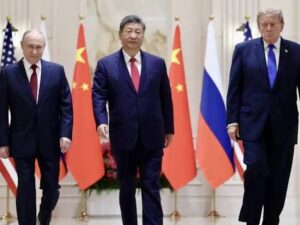
The leaders of China, the United States and Russia have committed to maintaining international security and pursuing dialogue to reduce nuclear risks following their first-ever trilateral summit in Shenzhen, China.
Chinese President Xi Jinping hosted US President Donald Trump and Russian President Vladimir Putin on Thursday, November 19, on the sidelines of the Asia-Pacific Economic Cooperation (APEC) summit.
The meeting produced a four-point joint declaration, setting out areas of cooperation on international security, United Nations reform, energy supplies and nuclear risk reduction. The declaration provides a framework for further engagement, but does not establish a comprehensive nuclear disarmament agreement or announce a resolution to the wars in Ukraine and Iran.
Leaders call for cooperation among major powers
Addressing the summit, Xi described the meeting as a significant diplomatic development, arguing that constructive relations among major powers were essential to international peace and stability.
He recalled the cooperation between China, Russia and the United States during the Second World War, when they fought together against fascism.
“More than 80 years ago, China, Russia and the United States, the key anti-fascist forces in the world, fought shoulder to shoulder and achieved great victories, winning peace and tranquillity for the world.
“History is the best textbook; we must remember history, and learn from it to shape the future,” Xi said.
The Chinese leader warned that rivalry among major powers could destabilise the international system. He proposed four principles for managing their relations: mutual respect, peaceful coexistence, win-win cooperation, and dialogue and consultation.
He urged the three countries to respect one another’s sovereignty, territorial integrity, political systems, development choices and legitimate national interests.
Xi also argued that confrontation was not inevitable and called for greater restraint in handling disagreements and sensitive issues.
Nuclear risk reduction, not a disarmament agreement
Nuclear security featured prominently in the discussions, with Xi reiterating that nuclear war must never be fought because no country could emerge victorious from such a conflict.
The joint declaration reaffirmed that position and committed the three countries to dialogue on reducing nuclear risks and preventing the proliferation of nuclear weapons.
However, the declaration did not set out a timetable, specific disarmament targets or a framework for eliminating existing nuclear arsenals. Its commitment is therefore focused on dialogue and risk reduction rather than an agreed programme of nuclear disarmament.
United Nations reform and energy cooperation
The leaders also agreed to pursue reforms of the United Nations to strengthen its ability to respond to global challenges and fulfil its mandate of maintaining international peace and security.
On economic cooperation, Xi called for the three countries to move beyond Cold War thinking and explore ways to combine their respective strengths in resources, manufacturing and consumption.
Energy security was another priority. The joint declaration stated that the three countries planned to increase the production and supply of refined petroleum products, while reaffirming the importance of stable energy flows.
The commitment comes amid continuing concerns about energy security and the reliability of global supply chains. However, the declaration did not specify production targets, implementation timelines or how the proposed cooperation would be coordinated.
Disagreement over international institutions
Another issue addressed in the declaration was the authority and jurisdiction of international institutions, particularly the International Criminal Court (ICC).
The leaders emphasised the principles of state consent and respect for the immunities of government officials. They also stated that the ICC and similar institutions must not abuse their jurisdiction.
The position places the court's exercise of authority within a wider debate about state sovereignty, international accountability and the limits of international legal institutions. The declaration did not provide further details on how the three countries intend to pursue the issue.
No breakthrough on Ukraine and Iran conflicts
Xi called for regular high-level engagements, open communication channels and crisis-prevention mechanisms to reduce misunderstandings and prevent disputes from escalating.
He also urged the three countries to encourage parties involved in international conflicts to pursue negotiations and resolve disagreements through political and diplomatic means.
Despite discussions on international security, the summit did not produce a specific agreement on ending Russia's war in Ukraine or the conflict involving Iran.
Putin described the trilateral format as useful and substantive, while Xi characterised the discussions as positive, constructive and fruitful.
Trump also welcomed the engagement, expressing optimism that cooperation among the three powers could help reduce nuclear weapons and prevent their use.
A diplomatic opening with questions over implementation
The Shenzhen summit brought together the leaders of three permanent members of the United Nations Security Council at a time of heightened geopolitical tensions.
Its immediate outcome was a declaration of shared principles and proposed areas of cooperation, rather than a comprehensive settlement of outstanding international disputes.
The practical significance of the meeting will depend on whether the commitments lead to sustained diplomatic engagement, measurable progress in reducing nuclear risks and concrete cooperation on energy and international security.
For now, the declaration establishes a basis for further discussions, while major questions surrounding nuclear weapons, Ukraine, Iran and the authority of international institutions remain unresolved.
Atlantic Reports: Voices. People. Facts.
Written by
Atlantic Reports Admin
Comments
- Be the first to comment.