Xi Unveils Eight Measures to Advance Global Governance Reforms
By Atlantic Reports
Chinese President Xi Jinping has unveiled eight measures aimed at reforming global governance, calling for stronger multilateral cooperation, more equitable representation and more effective international institutions.
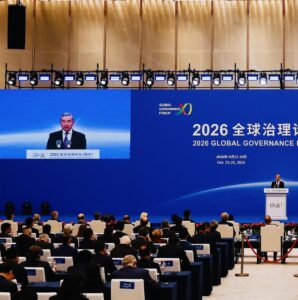
Xi, represented by Foreign Affairs Minister Wang Yi, announced the measures at the opening of the 2026 Global Governance Forum in Xiong’an, China.
The three-day forum is being held under the theme, “Rebuilding Confidence and Cooperation, Reforming and Improving Global Governance in a Transforming World.”
Xi said the measures were intended to advance China’s Global Governance Initiative (GGI), which seeks to promote what Beijing describes as a more just and equitable international system.
“I have put forward the Global Governance Initiative (GGI) to promote the building of a more just and equitable global governance system and a better world,” he said.
Eight Measures Outline China’s Priorities
The measures announced by Xi cover international institutions, trade, emerging technologies, environmental protection and research into global governance.
They include plans to host the Asia-Pacific Economic Cooperation (APEC) Economic Leaders’ Meeting, advance United Nations reform and strengthen the Group of Friends of Global Governance.
Other measures involve promoting the marine biodiversity agreement, reforming global human rights governance, publishing China’s position on outer space governance and reporting progress on inclusive artificial intelligence capacity-building.
China will also establish a Global Governance Research Centre to examine major policy and theoretical questions, publish a global governance index and produce annual reports.
The proposals reflect Beijing’s stated intention to expand international cooperation while encouraging changes to institutions and decision-making structures that it considers insufficiently representative.
Xi Calls for Stronger United Nations
Xi described the United Nations as indispensable to global governance and urged member states to protect its authority while pursuing reforms to improve its effectiveness.
He argued that the international system faced growing challenges relating to peace, development, security and governance amid rapid global changes.
“The world is undergoing accelerated transformation unseen in a century, and the deficits in peace, development, security and governance are growing rather than diminishing,” he said.
The Chinese president called on countries to strengthen multilateralism, respect sovereign equality and provide greater certainty in an increasingly unstable international environment.
He also stressed that countries should have opportunities to participate in international decision-making regardless of their size or economic and military strength.
China Pushes for Greater Representation of Developing Countries
Xi called for reforms to the international financial system and the United Nations Security Council to strengthen the representation of developing countries, particularly addressing Africa’s concerns.
He identified the BRICS grouping and the Shanghai Cooperation Organisation (SCO) as platforms through which countries of the Global South could contribute more actively to international governance.
The proposals reflect longstanding debates over the distribution of influence within global institutions, including demands for greater African representation in international decision-making.
However, the announcement did not specify the precise changes China is seeking to the composition of the Security Council or how the proposed reforms would be negotiated and implemented.
Trade and Sustainable Development
Xi warned against protectionism, describing international trade as an important driver of economic growth.
He urged countries to reaffirm their commitment to the World Trade Organisation’s multilateral trading system and called for development to remain central to international priorities.
He also urged accelerated implementation of the United Nations 2030 Agenda for Sustainable Development, which sets global targets covering poverty reduction, education, health, environmental protection and economic opportunity.
The proposals place economic cooperation and sustainable development among the priorities China wants international institutions to address.
AI, Outer Space and Marine Biodiversity
On emerging technologies, Xi advocated internationally agreed frameworks for artificial intelligence governance.
He also called for cooperation on outer space, marine biodiversity and other areas beyond the exclusive control of individual countries.
The measures include publishing China’s position on outer space governance and promoting an international agreement on marine biodiversity.
The growing use of artificial intelligence and increasing competition in space have intensified debates over safety, access, accountability and the rules governing emerging technologies.
International agreement on these issues remains dependent on negotiations among countries with differing economic interests, security priorities and regulatory approaches.
Xiong’an Forum Seeks Long-Term Solutions
Xi described Xiong’an New Area in Hebei Province as a long-term national development project and an experiment in modern governance, green development and high-quality growth.
He said hosting the forum in Xiong’an was intended to encourage participants to take a long-term view, share expertise and develop practical responses to global challenges.
The Chinese president expressed hope that discussions at the forum would advance reforms towards a more equitable global governance system.
Implementation Will Determine Impact
China’s eight measures set out priorities spanning international institutions, economic cooperation, environmental protection and emerging technologies.
Their practical significance will depend on how they are translated into proposals, negotiated with other countries and implemented through existing or new international arrangements.
Questions remain over the specific institutional changes envisaged, the role of other governments in shaping the proposals and the mechanisms for measuring progress.
For developing countries, including those in Africa, the central issue will be whether proposed reforms lead to meaningful participation in global decision-making and greater influence over policies affecting their economies, security and development.
Atlantic Reports: Voices. People. Facts.
Written by
Atlantic Reports Admin
Comments
- Be the first to comment.